


Science Art / phygital project “Convenient city” / experiment no. 06

ART&Science BRICS+
BRICS Media Center Decade of Science and Technology

Eternal Kindness Visualizing the Mind

Young volunteers — from medicine and sports to ecology and science — talked about what kindness means to them personally, while a mind-tracker recorded the response of their brain. That data became generation seeds: every work grew out of a genuine emotional experience.

n = 10 images · spectrum 7.8–13.8 Hz · seed = f(emotion)

View the collection

The exposition opens the BRICS Anniversary Week, marking 20 years of the union in 2026, with a large-scale international dialogue on meanings and the universal unifying concept of kindness.

“Each image is a blend of two layers: a person’s own story about kindness and objective data on what they felt while telling it”

The collection was created at the intersection of science and art using the in-house neural network of the phygital science-volunteering project “Convenient city”. It has already proven itself in studies of urban environments and quality of life.

During professional interviews about kindness, the participants’ emotional state was monitored with mind-tracking — a system that reads the frequency spectrum of brain activity. The moments of each respondent’s peak emotional expressiveness were turned into unique seeds — the numbers from which the visual noise of generation, the starting point of an image, is born.

10 works emotions → seeds mind-tracking the “Convenient city” neural network

How a work is born

  1. 01

    Interview

    Young volunteers talk about what kindness means to them personally: stories, memories, feelings.

  2. 02

    Mind-tracking

    While they speak, the system reads the frequency spectrum of brain activity — an objective trace of emotion that cannot be faked.

  3. 03

    Emotional peak

    The recording is searched for the moment of peak emotional expressiveness — the point where the story sounded strongest.

  4. 04

    Seed

    The peak data becomes a seed — the number from which the visual noise, the starting point of an image, is born.

  5. 05

    Generation

    The “Convenient city” neural network grows an image out of the noise. A personal experience becomes a painting.

seed 4829137506 · peak 9.6 Hz · α rhythm · “compassion”

Kindness in everyday life

The work is based on a young respondent’s story about helping an injured bird. The experience shook him and made him rethink what kindness is: good deeds can be done anywhere and at any time, and they begin with caring for the most vulnerable and innocent beings.

The work reminds us that anyone, at any age, can make the world better — through small acts of kindness that bring joy and harmony into everyday life.

seed 1735482914 · peak 10.4 Hz · α rhythm · “inspiration”

Kindness as an emotion of creation

Kindness is born inside a person and turns into a creative force. Warm oranges and reds flow into cool blues and whites — a contrast that carries the dynamics and energy of kindness, a feeling of warmth and light.

The butterflies fluttering around the heroine are a symbol of transformation and rebirth: kind thoughts and deeds, bursting outward, bring beauty into the world. Kindness is not only deeds but an inner state that transforms everything around it.

seed 6012794835 · peak 13.8 Hz · β rhythm · “resolve”

Kindness as action

Kindness as active doing, embodied in the collective effort of volunteers. The silhouettes of people planting trees are slightly blurred and abstract — a universal image of a shared good deed anyone could join.

The bright, contrasting tones of the background — from warm oranges to cool blues and greens — foretell the transformation of the space into a living, blooming environment. Working together for a good cause bears fruit that inspires and unites.

Diptych: giving and receiving

Two paintings about the dual nature of kindness — the capacity to share and the ability to receive. Every act of kindness enriches both the world around us and the inner world of the person, creating harmony and balance.

seed 2340856108 · peak 8.9 Hz · α rhythm · “generosity”

Kindness as the ability to give

Hands gently holding a glowing sphere are a metaphor for the inner light a person gives to others. Powerful and caring at once, they symbolize strength and readiness to help. The saturated oranges and yellows of the background flow into blues and pinks, underscoring the liveliness of the act.

seed 2340856109 · peak 9.1 Hz · α rhythm · “gratitude”

Kindness as the ability to receive

Here the sphere’s light is accumulated energy, warmth and wisdom a person receives through good deeds. The deep blue tones of the background contrast with the bright glow: kindness received is transformed into personal strength and inner light.

seed 7521639402 · peak 11.7 Hz · α rhythm · “joy”

Kindness as joy

Most respondents noted that kindness is felt, on an emotional level, as joy in its many forms. The hero of the work, arms spread wide and looking up with a broad smile, conveys exactly that — sincere joy born of good deeds.

True joy comes through acts of kindness: each one becomes a source of inner light that brightens the path not only of the person but of everyone nearby.

seed 3184290657 · peak 12.5 Hz · β rhythm · “trust”

Kindness as interaction

The central element of this dynamic work is hands — a symbol of human interaction and support. Kindness shows itself through cooperation and joint effort capable of changing the world for the better.

Every gesture of help creates a wave of positive change that touches everyone involved.

seed 5490312768 · peak 7.8 Hz · θ rhythm · “contemplation”

Kindness as meaning

A girl with closed eyes in a white dress is shown in a moment of inner contemplation: kindness begins with thoughts and feelings that are later embodied in actions. The butterflies around her are those thoughts and deeds, scattering and carrying kindness into the world.

Kindness is more than simple actions: it is deep, many-layered meaning that each of us can carry within and share with others.

seed 4015687329 · peak 9.3 Hz · α rhythm · “tenderness”

Kindness as care

A young man and a young woman stand face to face holding a glowing sphere — a metaphor for kindness and care. Its light illuminates their faces, creating a sense of harmony and unity, while the soft, muted tones of the background create an atmosphere of warmth.

True kindness shows itself in attention to others: every act of care and support strengthens the emotional bond and brings light and warmth into people’s lives.

seed 8801245963 · peak 10.9 Hz · α rhythm · “hope”

Kindness as the foundation of the future

A human silhouette stands on a lit path leading to a bright horizon. The facelessness of the figure makes the image universal: it is each of us. The radiance at the center is hope and the bright future the path of kindness leads to.

The small glowing halos around it are good deeds that, like stars, light the way. Kindness is not only the present: every good deed lays a foundation for generations to come.

Three words you need to understand the collection

Seed
The “grain” number of generation. Usually it is chosen at random — in this collection it was set by human emotion.
Mind-tracking
A system that reads cognitive load and the frequency spectrum of brain activity; it reveals the emotional perception of objects and situations.
Science Art
A field at the intersection of science and art, where the artistic image rests on data from real research.

note 01 · method

What is mind-tracking

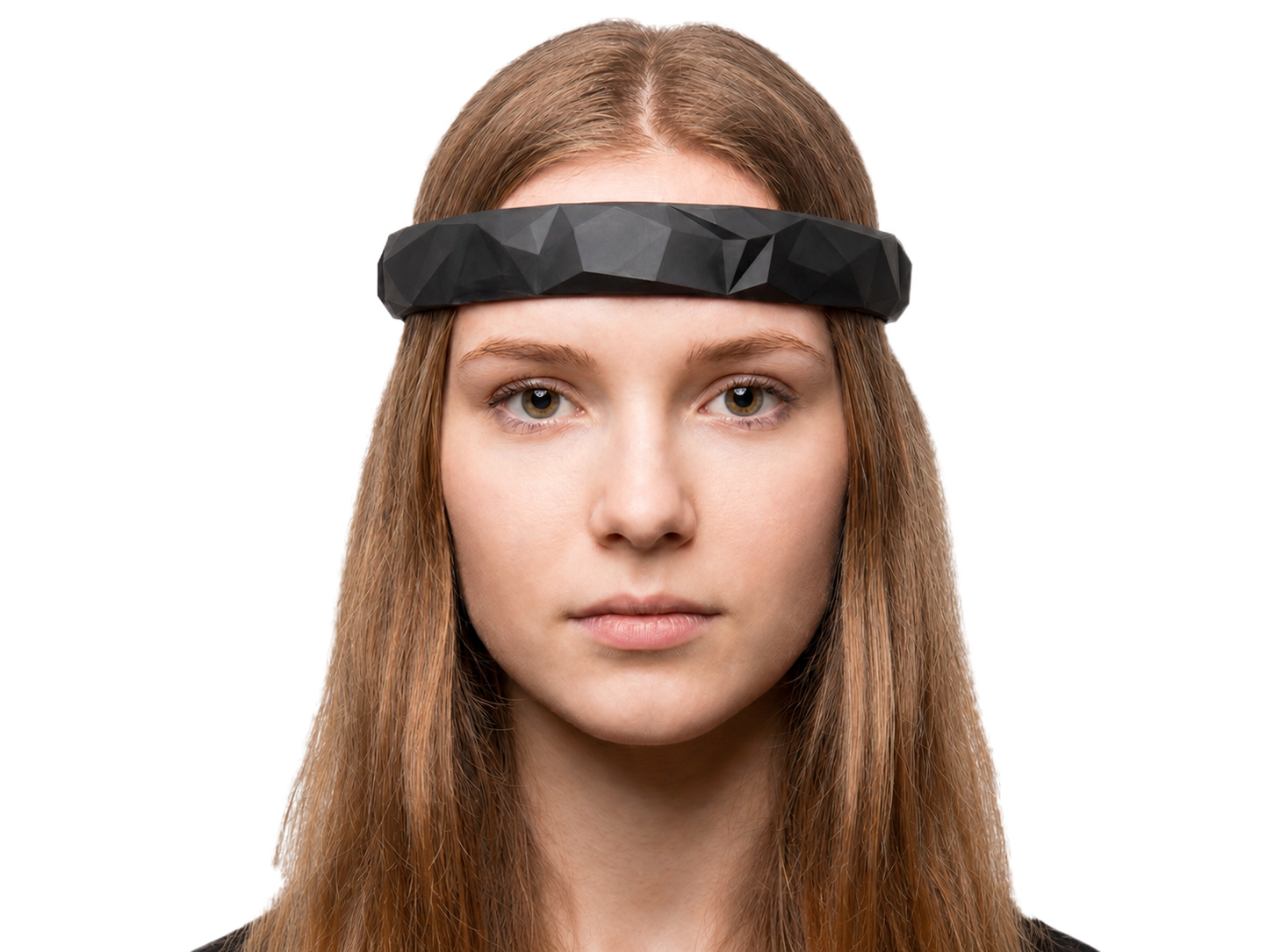
A mind-tracker — a wearable neural interface

Mind-tracking is a technology for recording and analysing neurophysiological signals that helps understand how a person responds to a visual environment, digital content, an exhibition, urban space or an interactive object. Unlike a survey, where the participant is already interpreting and putting the answer into words, mind-tracking reveals an earlier level of response: concentration of attention, engagement, signs of tension, fatigue or calm interest.

In research, such data does not “read minds” or make medical diagnoses. It helps assess the dynamics of a person’s state while they interact with a space or object. Algorithms analyse the features of the EEG signal: activity in different frequency bands, changes in indicators over time and differences between recording zones. In the “Convenient city” project, mind-tracking complements eye-tracking, questionnaires, attention heat maps and AI analysis to study the perception of an environment in a more complete way — not only through the eyes, but also through cognitive load and emotional engagement.

note 02 · format

What is science volunteering

Science volunteering is the participation of citizens in real scientific research under the guidance of researchers and expert teams. Volunteers can help collect data, take part in experiments, label materials, test digital tools, join observations, surveys and the processing of results. This format is often called citizen science: it makes research more open and brings science closer to people.

You do not have to be a professional scientist or hold a special degree to take part. What matters is following the methodology, working carefully with data and understanding why the research is being done. For science it is a way to gather large bodies of information that a single laboratory could hardly collect on its own. For participants it is a chance to try the role of a researcher, get to know modern technologies, develop digital and analytical skills and make a personal contribution to solving real scientific and social problems.

note 03 · field

What are art-science projects

Art-science projects are projects at the intersection of science, art and technology. In them, scientific data, research methods, digital tools, biotechnology, artificial intelligence, VR/AR, sound, light, visual images and interactive formats become part of an artistic statement. This approach makes it possible to talk about complex scientific topics in a language that is clear and emotionally close to a wide audience.

In art-science projects, art does not merely “decorate” science — it helps see the research question in a new way. The viewer can not only read about a phenomenon but also live it through image, space, movement, sound or interaction. For “Convenient city” this is especially important: phygital exhibitions, VR/AR objects, digital expositions and perception studies bring together the scientific approach, cultural memory, modern technologies and the participant’s personal experience.